

Blood Gas Analyzers Market Forecast 2026–2036: Market to Reach USD 3.6 Billion by 2036 at 6.6% CAGR
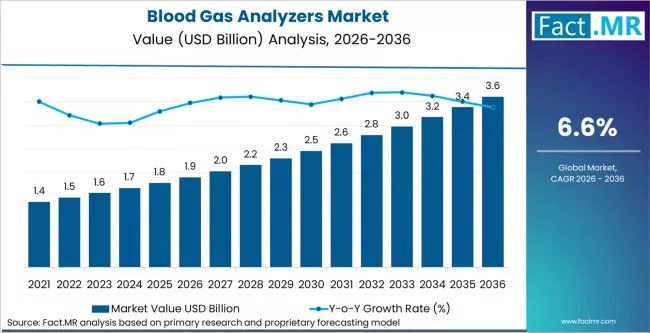
The expansion is anchored by a fundamental shift in critical care protocols. In an era where respiratory distress, metabolic emergencies, and neonatal intensive care demand results in seconds rather than minutes, blood gas analyzers have evolved from specialized lab equipment into essential bedside tools. This evolution is enabling physicians to pre-activate life-saving interventions, such as massive transfusion protocols or ventilator adjustments, directly at the point of impact.
Request for Sample Report | Customize Report | Purchase Full Report - https://www.factmr.com/connectus/sample?flag=S&rep_id=14426
Market Growth Drivers: The Architecture of Immediate Intervention
The trajectory of the market is defined by a convergence of clinical necessity and infrastructure modernization:
Point-of-Care (POC) Adoption: The push to eliminate transport delays to central laboratories is driving the mass installation of portable analyzers that deliver results in under two minutes.
Expanding ICU Infrastructure: A global increase in ICU bed capacity, particularly in emerging economies, is creating a high-volume, predictable revenue stream for both capital equipment and recurring consumables.
Rising Chronic Respiratory Burden: The escalating prevalence of COPD, asthma, and other chronic conditions in urban hubs is increasing the frequency of arterial blood-gas (ABG) monitoring.
Emerging Trends: The Power of Portability and Connectivity
A defining trend in the 2026 landscape is the dominance of Portable Analyzers, which are projected to capture 43.4% of the global market share. These battery-powered, wireless units are now standard equipment in ambulances and trauma centers, allowing for real-time data synchronization with Hospital Information Systems (HIS) via Wi-Fi or Bluetooth.
Furthermore, Intensive Care Units (ICUs) remain the leading application segment, accounting for 40.2% of market value. Because each ICU bed typically requires multiple tests per day, this segment represents the most significant "absolute dollar opportunity" for reagent and cartridge suppliers over the next ten years.
Regional Insights: China and India Lead the Global Growth Curve
While North America remains the highest unit-value market, the Asia-Pacific region is experiencing the most rapid infrastructure development:
China: Leading global growth with a 9.0% CAGR, supported by national mandates that require dedicated blood gas monitoring in all Grade-3 tertiary hospitals.
India: Projecting a robust 8.6% CAGR, fueled by the expansion of the Ayushman Bharat scheme, which has broadened reimbursement for critical care diagnostics.
Germany: Maintaining a strong 8.4% CAGR, where strict quality standards (DIN EN ISO 22870) trigger regular procurement cycles for high-precision analyzer upgrades.
United States: Growing at 6.8%, centered on the decentralization of diagnostics and the integration of telehealth-enabled monitoring systems.
Competitive Landscape
The competitive arena is characterized by a mix of diagnostic giants and specialized innovators focusing on cartridge-based, maintenance-free systems. Strategic advantage is increasingly consolidating around vendors who can offer low-volume, high-accuracy testing for neonatal applications and integrated electrolyte monitoring.
Key companies identified in the industry landscape include: Danaher Corporation, Werfen S.A., F. Hoffmann-La Roche Ltd., Abbott Laboratories, Siemens Healthineers AG, Nova Biomedical, Medica Corporation, Techno Medica Co., Ltd., IDEXX Laboratories, Inc., EDAN Instruments, Inc., Guangzhou Wondfo Biotech Co., Ltd.
Analyst Strategic Outlook
"We are moving past the era where blood gas analysis was a 'lab-only' function," says a Lead Healthcare Analyst at Fact.MR. "Between 2026 and 2036, the market is expected to create an absolute dollar opportunity of USD 1.7 billion. The growth is no longer just about analytical throughput; it’s about the integration of 'smart' surveillance systems that can flag respiratory failure before it becomes a code blue event."
Conclusion: Navigating Future Opportunities
The blood gas analyzers market stands at the intersection of medical innovation and emergency resilience. As healthcare facilities prioritize workflow efficiency and bedside accuracy, the role of these specialized diagnostic tools will only intensify. For investors and healthcare executives, the focus is now on adopting "validated" POC solutions that can handle the escalating complexity of the modern intensive care environment.
To View Related Report:
Automated Blood Tube Labeler & Specimen Transport Box Market https://www.factmr.com/report/automated-blood-tube-labeler-and-specimen-transport-box-market
Surgical Kits Market https://www.factmr.com/report/surgical-kits-market
Gel Documentation Systems Market https://www.factmr.com/report/gel-documentation-systems-market
Knee Cartilage Repair Market https://www.factmr.com/report/knee-cartilage-repair-market
About Fact.MR
Fact.MR is a global market research and consulting firm, trusted by Fortune 500 companies and emerging businesses for reliable insights and strategic intelligence. With a presence across the U.S., UK, India, and Dubai, we deliver data-driven research and tailored consulting solutions across 30+ industries and 1,000+ markets. Backed by deep expertise and advanced analytics, Fact.MR helps organizations uncover opportunities, reduce risks, and make informed decisions for sustainable growth.
S. N. Jha
Fact.MR
+ +1 628-251-1583
email us here
Legal Disclaimer:
EIN Presswire provides this news content "as is" without warranty of any kind. We do not accept any responsibility or liability for the accuracy, content, images, videos, licenses, completeness, legality, or reliability of the information contained in this article. If you have any complaints or copyright issues related to this article, kindly contact the author above.
