

Preclinical Imaging Market to reach USD 7.78 Billion by 2035 at 5.10% CAGR
Preclinical Imaging Market Size
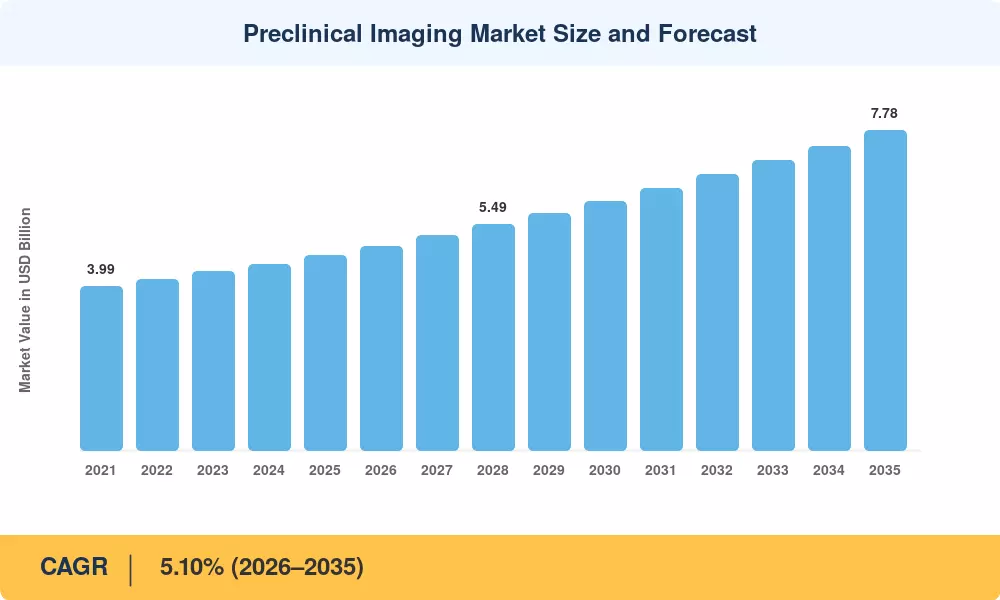
Preclinical Imaging Market to Surge from USD 4.73 Bn in 2025 to USD 7.78 Bn by 2035-By Expanding Biopharmaceutical R&D, Multimodal & Hybrid Imaging Technologies
NY, CA, UNITED STATES, August 17, 2026 /EINPresswire.com/ -- As per Market Research Future, the global Preclinical Imaging Market size was valued at USD 4.50 Billion in 2024 and is projected to grow from USD 4.73 Billion in 2025 to USD 7.78 Billion by 2035, exhibiting a CAGR of 5.10% during the forecast period 2026--2035.The 5.10% CAGR is being supported by three converging forces: sustained escalation in global pharmaceutical and biotechnology R&D expenditure, expanding government funding for biomedical research infrastructure, and continuous technological breakthroughs in AI-integrated, multimodal preclinical scanners. Preclinical imaging modalities offer non-invasive, high-resolution longitudinal visualization of biological processes, significantly accelerating early-stage drug discovery, candidate validation, and translational pipeline efficiency.
Academic institutions, pharmaceutical companies, and contract research organizations (CROs) are increasingly adopting advanced preclinical imaging platforms across oncology, neurology, cardiology, and infectious disease research. High demand for quantitative longitudinal biomarker tracking, hybrid micro-PET/CT, micro-SPECT/CT, and optical imaging systems is broadening the addressable market. North America remains the dominant regional market, while Asia-Pacific is the fastest-growing region as biopharmaceutical investments and CRO service capacity surge.
Request A Free Sample: https://www.marketresearchfuture.com/sample_request/7365
Key Market Trends & Growth Drivers
Surging Pharmaceutical & Biotechnology R&D Spending
Global biopharmaceutical R&D expenditure—pegged at over USD 260 billion annually—is driving sustained investment in high-throughput preclinical research tools. Drug developers face increasing pressure to identify efficacy, biodistribution, and safety bottlenecks early in the translational pipeline to avoid costly late-stage clinical failures.
Preclinical imaging provides non-invasive, longitudinal quantitative assessments in live animal models, allowing researchers to evaluate compound therapeutic response over time using fewer animal subjects. As pipeline focus shifts toward targeted biologic therapeutics, gene therapies, and precision medicine, small-animal imaging has become an essential drug discovery requirement.
Technological Advancements & AI Integration in Scanners
Continuous technical innovation is transforming preclinical scanner performance, spatial resolution, and data acquisition speed. Modern platforms feature silicon photomultiplier (SiPM) PET detectors, high-sensitivity CCD/CMOS cameras for bioluminescence/fluorescence, and ultra-high-field MRI magnets that deliver unprecedented anatomical and functional clarity.
AI and machine learning integration represents a transformative growth engine. AI algorithms support automated image segmentation, tissue characterization, rapid 3D volumetric reconstruction, and parameter optimization. Equipment manufacturers are actively focusing on software-hardware co-design to deliver automated, high-throughput, and cloud-connected imaging workflows.
Explosive Growth of Radiopharmaceuticals & Immuno-Oncology Pipeline
The dramatic rise of radiopharmaceutical therapeutics (RPTs) and novel theranostic constructs is driving massive demand for nuclear imaging modalities such as micro-PET and micro-SPECT. Every emerging theranostic and targeted radioligand candidate requires rigorous small-animal organ-level dosimetry, target specificity, and pharmacokinetic evaluation.
Simultaneously, immuno-oncology research requires real-time visualization of immune cell trafficking, tumor microenvironment response, and biomarker expression, cementing preclinical optical and hybrid imaging as indispensable research assets.
Ask for Customization: https://www.marketresearchfuture.com/ask_for_customize/7365
Market Segment Insights
BY MODALITY
Optical Imaging Systems: Dominant modality segment capturing approximately 37.2% of market revenue in 2025. Demand is anchored by cost advantages, high sensitivity, ease of operation, and widespread adoption in bioluminescence and fluorescence oncology models.
Nuclear Imaging (Micro-PET / Micro-SPECT): Established high-precision category driven by radiopharmaceutical development, targeted molecular probe design, and quantitative metabolic tracking.
Micro-MRI Systems: High-growth structural modality providing superior soft-tissue contrast, critical for neuroimaging, cardiovascular studies, and anatomical soft-tissue pathology.
Micro-CT Systems: Widespread high-resolution anatomical imaging modality heavily utilized in bone density, pulmonary imaging, structural biomarker tracking, and vascular calcification studies.
Hybrid & Multimodal Imaging Platforms: Fastest-growing technology category advancing at over 10.1% CAGR, driven by demand for co-registered functional and anatomical data streams (PET/CT, PET/MRI, SPECT/CT) in a single acquisition session.
BY APPLICATION
Oncology: Dominant application segment accounting for 42.3% of total market share in 2025, driven by therapeutic pipeline expansion in immuno-oncology, targeted targeted therapies, and tumor microenvironment characterization.
Neurology: Fast-growing application projected to register a 10.7% CAGR, supported by escalating global research funding for neurodegenerative disorders, including Alzheimer's, Parkinson's, and ALS.
Cardiology: Major application supported by preclinical research into ischemic heart disease, myocardial infarction recovery, and novel cardiovascular therapeutics.
Infectious Diseases: Expanding application as researchers utilize real-time pathogen tracking and host-immune dynamics in live animal models.
Other Applications: Includes preclinical metabolic disease research, bone pathology, regenerative medicine, and toxicological screening.
BY END USER
Pharmaceutical & Biotechnology Companies: Leading end-user segment representing 48.1% of market revenue in 2025, deploying high-throughput scanners across internal drug discovery platforms.
Contract Research Organizations (CROs): Fastest-growing end-user category with a projected 12.1% CAGR through 2035, driven by biopharma outsourcing trends and expanded CRO preclinical service offerings.
Academic & Research Institutes: Core user segment underpinned by government research grants (e.g., NIH, Horizon Europe) funding core imaging facilities and basic disease biology research.
Read Detailed Insights: https://www.marketresearchfuture.com/reports/preclinical-imaging-market-7365
Regional Outlook
North America --- Dominant Market (~51.0% Share, 2025)
North America led the global Preclinical Imaging Market with over 51.0% share in 2025. Advanced academic medical center networks, dense biopharmaceutical clusters, and substantial federal research grants (e.g., NIH funding of USD 48 billion in FY2025) anchor the region's market leadership.
The United States represents over 82% of regional market revenue, driven by intense biopharmaceutical drug development, strong capital infrastructure, and rapid early adoption of novel AI-driven hybrid imaging systems.
Europe --- Established Research Hub (~24.0% Share)
Europe holds the second-largest market share (~24%), supported by mature scientific infrastructure, Horizon Europe research grants, and strong regulatory initiatives promoting 3Rs (Replacement, Reduction, Refinement) in animal research.
Germany is the leading national market in Europe (accounting for ~28% of regional share), followed by the UK, France, and Switzerland, supported by world-class academic institutions and active preclinical contract research sectors.
Asia-Pacific --- Fastest-Growing Region (9.80% CAGR)
Asia-Pacific is the fastest-growing regional market, expanding at a 9.80% CAGR through 2035, propelled by expanding pharmaceutical R&D, rapid establishment of CRO hubs, and substantial biomedical infrastructure investments.
China leads regional growth, accelerated by government support under national biomedical innovation initiatives. India, Japan, and South Korea are also expanding rapidly, backed by growing preclinical drug screening activities and rising academic core facility investments.
South America --- Emerging Market
South America represents an emerging growth market projected to expand steadily, reaching USD 564.9 Million by 2035. Growth is driven by expanding university research capabilities and biopharmaceutical investments in Brazil and Argentina.
Middle East & Africa --- Growing Infrastructure
The Middle East & Africa market is gaining momentum as regional healthcare entities and governments invest in specialized biomedical research hubs, advanced imaging facilities, and academic infrastructure in GCC nations.
Competitive Landscape and Recent Developments
The Preclinical Imaging Market features a mix of established scientific instrument manufacturers, specialized molecular imaging providers, and advanced optical software developers. Competition centers on spatial resolution, multimodal registration accuracy, software automation, AI quantification pipelines, and total cost of ownership.
Major participants identified by Market Research Future include Bruker Corporation, Revvity (PerkinElmer), FUJIFILM VisualSonics Inc., Mediso Ltd., MILabs B.V. (Rigaku), MR Solutions, TriFoil Imaging, Vieworks Co., Ltd., and Siemens Healthineers. Industry developments center on multimodal system upgrades, cloud imaging platforms, and strategic acquisitions.
KEY COMPANIES AND RECENT MILESTONES
Bruker Corporation (2024--2026): Unveiled advanced silicon-photomultiplier (SiPM) PET/CT platforms and upgraded high-field micro-MRI systems, strengthening leadership in high-resolution molecular imaging.
Revvity / PerkinElmer (2024--2026): Expanded its IVIS optical imaging portfolio with cloud-connected image analysis suites and high-sensitivity fluorescence spectrum capabilities.
Mediso Ltd. (2024--2026): Advanced its nanoScan PET/CT and SPECT/CT multimodal systems, catering to expanding demand in radiopharmaceutical theranostics research.
MILabs B.V. (2024--2026): Enhanced multi-modality integration across SPECT, PET, CT, and Optical modalities on a single adaptive benchtop platform.
FUJIFILM VisualSonics (2024--2026): Introduced next-generation high-frequency ultrasound and photoacoustic imaging systems tailored for microvascular and cardiovascular research.
Future Outlook: 2026--2035
By 2035, preclinical imaging environments will become increasingly automated, cloud-integrated, and software-driven. AI-assisted organ segmentation and automated lesion tracking will standardize quantitative longitudinal measurements across multi-center drug trials.
Benchtop multimodal systems that offer true co-registration (e.g., simultaneous PET/MRI or Optical/CT) with reduced footprint will increase accessibility for mid-tier academic laboratories and specialty CRO facilities.
Furthermore, the convergence of preclinical imaging data with multi-omics translational datasets will position small-animal imaging as a central pillar of target discovery and AI-assisted biopharmaceutical design.
More Related Research Insights:
https://www.marketresearchfuture.com/reports/medical-writing-market-8370
https://www.marketresearchfuture.com/reports/multimodal-imaging-market-41061
https://www.marketresearchfuture.com/reports/neuromodulation-devices-market-1337
https://www.marketresearchfuture.com/reports/non-emergency-medical-transportation-market-42179
https://www.marketresearchfuture.com/reports/particle-therapy-market-7000
https://www.marketresearchfuture.com/reports/protein-sequencing-market-6828
https://www.marketresearchfuture.com/reports/surgical-equipment-market-556
https://www.marketresearchfuture.com/reports/surrogacy-market-22754
https://www.marketresearchfuture.com/reports/synthetic-biology-market-10901
https://www.marketresearchfuture.com/reports/tangential-flow-filtration-market-21542
Larry Wilson
WantStats Research And Media Pvt. Ltd.
+1 855-661-4441
email us here
Visit us on social media:
LinkedIn
Facebook
YouTube
X
Legal Disclaimer:
EIN Presswire provides this news content "as is" without warranty of any kind. We do not accept any responsibility or liability for the accuracy, content, images, videos, licenses, completeness, legality, or reliability of the information contained in this article. If you have any complaints or copyright issues related to this article, kindly contact the author above.
