

MOPE Clinic Highlights Cash-Pay Lab Pricing and Healthcare Cost Transparency
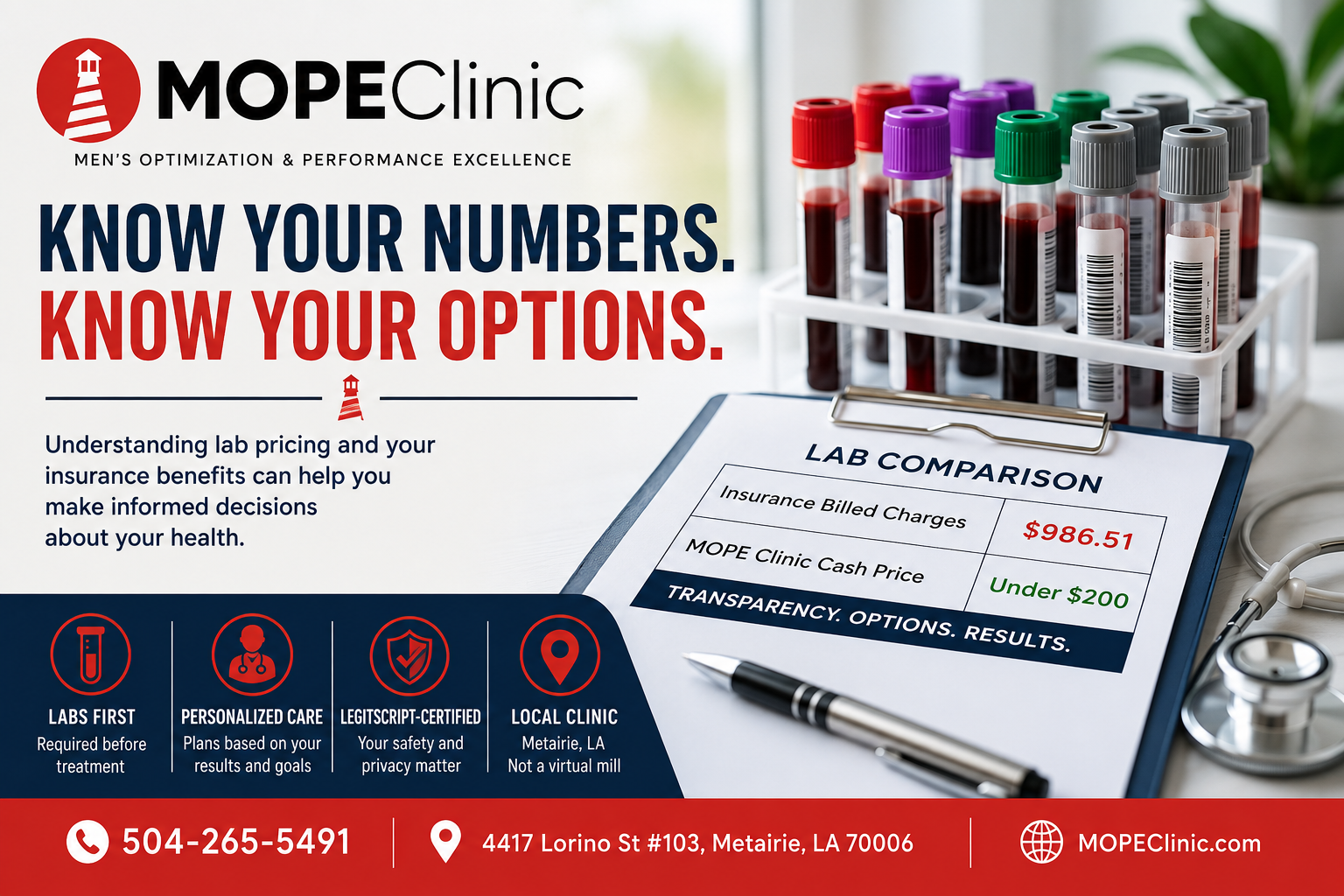
MOPE Clinic in Metairie, Louisiana highlights healthcare price transparency and encourages patients to compare listed lab charges, insurance benefits and available cash-pay options.
MOPE Clinic uses a recent lab invoice to explain why patients should compare cash-pay pricing and insurance costs before routine bloodwork.
COVINGTON, LA, UNITED STATES, August 17, 2026 /EINPresswire.com/ -- A laboratory invoice showing $986.51 in listed charges for a group of blood tests has prompted MOPE Clinic in Metairie to encourage Louisiana patients to learn more about healthcare pricing before scheduled laboratory work.
The tests shown on the invoice included a complete blood count with differential, comprehensive metabolic panel, free testosterone, estradiol, sex hormone-binding globulin, prostate-specific antigen, dihydrotestosterone and venipuncture.
Chris Rue, APRN, FNP-C, of MOPE Clinic said the clinic's cash-pay price for the same listed group of laboratory tests is less than $200.
However, the comparison requires an important distinction.
The $986.51 figure represents charges listed on the laboratory invoice. It does not necessarily represent what an insured patient would ultimately pay after the claim is processed. Insurance-negotiated rates, network status, deductibles, copayments, coinsurance and the terms of an individual health plan can all affect final patient responsibility.
Rue said that distinction is exactly why the invoice created an opportunity for a broader conversation about healthcare price transparency.
“Patients often ask whether we take insurance, but there is another useful question they can ask: ‘What will this actually cost me?’” Rue said. “Insurance can absolutely be the better financial option in some situations. In others, a cash price may be worth considering. Patients should have enough information to compare their options.”
One Healthcare Service Can Have Different Prices
Healthcare pricing can be confusing because a single service does not always have one universal price.
For example, a provider may have a listed charge. An insurance company may have a negotiated rate for the service. A healthcare organization may also offer a separate price to patients who pay directly.
The Centers for Medicare & Medicaid Services recognizes several different pricing concepts in its hospital price-transparency requirements, including gross charges, discounted cash prices and payer-specific negotiated charges.
Those federal hospital requirements do not apply identically to every independent medical clinic or laboratory. Still, the terminology helps illustrate an important point for consumers: the amount appearing as a charge is not necessarily the only price associated with a healthcare service.
CMS also identifies certain laboratory tests among healthcare services that consumers may be able to schedule in advance and compare.
That makes routine, scheduled bloodwork different from an emergency medical situation in which shopping for prices may be unrealistic or inappropriate.
Understanding Deductibles, Coinsurance and Allowed Amounts
Insurance coverage can add another layer to the calculation.
HealthCare.gov defines a deductible as the amount a person pays for covered healthcare services before the insurance plan begins paying according to its terms.
After meeting a deductible, a patient may still have other costs. Coinsurance, for example, is generally the percentage of the cost of a covered service that a patient pays after satisfying the deductible.
Another important term is the allowed amount. This generally refers to the maximum amount a health plan will recognize for a covered healthcare service under the plan's rules.
As a result, the listed amount on an invoice should not automatically be interpreted as the amount an insured patient will owe.
Consider two people receiving similar laboratory tests. One may have already met a deductible and have favorable laboratory benefits. The other may be early in a high-deductible plan year and responsible for substantially more of the allowed cost.
Their laboratory tests could be similar while their personal costs are very different.
That is why Rue cautions against assuming either insurance or cash payment is automatically the least expensive choice.
“The point isn't to tell everybody to stop using insurance,” Rue said. “The point is to understand your own situation. Get the cash price, understand your insurance benefits and compare the same services before making a decision.”
DIY Tips: Questions to Ask Before Scheduled Bloodwork
Patients do not need to become medical billing experts to ask useful questions about scheduled laboratory costs.
For routine, non-emergency testing, MOPE Clinic suggests considering the following steps:
1. Find out exactly which tests were ordered.
Request the names of the laboratory tests so that any price comparison involves the same services.
2. Ask for the total cash-pay price.
Instead of asking only whether cash pricing is available, ask what the complete group of ordered tests would cost and whether routine draw fees are included.
3. Contact the insurance company.
Using the customer-service number on the insurance card, patients can ask about laboratory benefits and their estimated responsibility.
4. Verify network status.
A laboratory's network status can affect insurance benefits. Patients should confirm the specific laboratory rather than assuming every location operates under the same terms.
5. Review the deductible.
Knowing how much of the annual deductible has already been met can provide important context.
6. Ask about coinsurance or copayments.
Meeting a deductible does not necessarily mean every later service is free.
7. Compare the same tests.
A lower-priced “hormone panel” may contain fewer tests. Comparing only the headline price can therefore be misleading.
8. Ask what happens if cash is used.
Before choosing a self-pay option, patients may want to ask their insurer whether that payment can be applied toward their deductible or annual out-of-pocket limit. Plan rules vary, so patients should not assume that it will.
9. Keep copies of laboratory results.
Maintaining personal copies can make it easier to discuss previous results and trends with a healthcare provider.
Lower Cost Is Not the Only Goal
Although the invoice prompted a discussion about cost, Rue said inexpensive testing alone is not the goal.
The more important question is whether the appropriate tests are being ordered for the individual patient.
Laboratory panels can vary considerably. Two packages marketed with similar names may test different biomarkers or serve different purposes.
For hormone evaluation, testing decisions can also depend on symptoms, medical history, age, medications, previous results and whether a patient is already receiving treatment.
Therefore, comparing a small screening panel with a broader clinician-ordered panel based only on total price may not provide a meaningful comparison.
“Affordable testing is valuable, but appropriate testing is more important,” Rue said. “We want the laboratory work to answer useful clinical questions. Ordering a cheap test that doesn't provide the information we need doesn't help the patient.”
Why MOPE Clinic Requires Labs Before Hormone Treatment
The same principle applies to testosterone replacement therapy and other hormone treatments.
MOPE Clinic requires laboratory testing before treatment.
Symptoms such as fatigue, reduced libido, changes in body composition, difficulty concentrating or reduced performance can be associated with many different medical and lifestyle factors. Symptoms alone cannot establish testosterone deficiency.
The Endocrine Society's clinical guidance recommends diagnosing male hypogonadism in men who have compatible symptoms and signs together with consistently low serum testosterone concentrations. It also recommends confirming an initial low testosterone result with repeat morning testing.
Therefore, MOPE Clinic does not use an online symptom questionnaire as an automatic pathway to medication.
Laboratory results are reviewed along with symptoms, medical history and other relevant clinical information. If treatment is appropriate, the plan is then personalized for the patient.
“Bloodwork gives us objective information,” Rue said. “The next step is putting those numbers into context. Treatment should follow a medical evaluation, not simply a completed questionnaire.”
Why This Conversation Matters in South Louisiana
Healthcare costs are a national concern, but individual decisions happen locally.
Residents of Metairie, New Orleans, Kenner and surrounding South Louisiana communities may receive laboratory services through hospitals, independent laboratories, physician practices and specialty medical clinics.
Each setting may have different pricing arrangements.
Meanwhile, insurance plans can vary significantly from one patient to another.
For a person scheduling routine bloodwork, taking a few minutes to ask about pricing may provide useful information before the service is performed.
Federal healthcare policy has increasingly emphasized that consumers should have access to meaningful pricing information for services that can be planned in advance. In 2026, CMS further updated hospital price-transparency requirements intended to improve the clarity and usefulness of publicly available pricing data.
Still, published prices cannot tell every patient exactly what he or she will owe. Individual insurance benefits remain an important part of the calculation.
For that reason, Rue recommends treating price transparency as a tool for asking better questions rather than as a reason to automatically choose one payment method over another.
Frequently Asked Questions About Cash-Pay Labs and Insurance
-Are cash-pay labs always cheaper than using insurance?
No. Cash payment may be less expensive in some situations, while insurance may provide a lower patient cost in others. The answer depends on the tests, cash price, negotiated insurance amount, network status, deductible, copayments, coinsurance and individual benefits.
-Does the $986.51 invoice mean the patient had to pay $986.51?
No. The $986.51 figure represents listed charges appearing on the laboratory invoice that prompted this discussion. It should not be interpreted as the insured patient's final out-of-pocket responsibility.
-Can someone with health insurance still ask about a cash price?
Yes. Patients can ask whether a self-pay option is available. However, they should also understand how choosing that option could affect their insurance benefits.
-Will a cash laboratory payment count toward my deductible?
Not necessarily. Insurance plan rules vary. Patients should ask their insurer before assuming that a direct cash payment will count toward a deductible or out-of-pocket maximum.
-Why can an insurance price and a cash price be different?
Healthcare organizations and insurers may have negotiated rates, while providers may separately establish self-pay prices. Patient responsibility can then be affected by the specific insurance plan.
-How can I compare laboratory prices correctly?
Compare the same tests. Request the exact names of the ordered laboratory services and determine whether additional fees, such as routine venipuncture, are included.
-Is the cheapest hormone panel automatically the best choice?
No. A lower-cost panel may contain fewer tests or may not provide the information a healthcare provider needs for an individual evaluation.
-What laboratory tests are required before TRT?
There is no single laboratory panel that is appropriate for every person. Testing decisions can depend on symptoms, medical history, age, medications, previous results and other clinical factors.
-Does abnormal bloodwork automatically mean someone needs testosterone therapy?
No. Laboratory results are one part of a medical evaluation. A licensed healthcare provider must determine whether treatment is clinically appropriate.
-Does getting bloodwork at MOPE Clinic guarantee a testosterone prescription?
No. Laboratory testing is required before treatment, but completing testing does not guarantee that medication will be prescribed.
-Is MOPE Clinic a virtual-only hormone provider?
No. MOPE Clinic operates a physical medical clinic in Metairie, Louisiana. The clinic also uses laboratory testing and individualized medical evaluation as part of its treatment process.
A Simple Question Can Start the Conversation
For patients preparing for routine bloodwork, Rue said the takeaway can be reduced to a few straightforward questions:
What tests am I getting? Why are they being ordered? What is the cash price? What does my insurance plan estimate I will owe?
Those questions may not make healthcare billing simple. However, they can give patients more information before a scheduled service rather than after a bill arrives.
About MOPE Clinic
MOPE Clinic is a LegitScript-certified medical clinic located at 4417 Lorino St #103 in Metairie, Louisiana. The clinic provides hormone evaluation and personalized medical care for men and women in Greater New Orleans and communities throughout South Louisiana. Laboratory testing is required before treatment, and treatment plans are developed after individualized medical evaluation.
Medical and Pricing Disclaimer: This information is provided for general educational purposes and is not individualized medical, insurance or financial advice. Laboratory prices, insurance coverage and patient responsibility vary by provider, health plan and individual circumstances. The $986.51 example represents listed charges appearing on one laboratory invoice and should not be interpreted as the insured patient's final out-of-pocket responsibility.
Gwen M.
Designs For You
email us here
Visit us on social media:
Facebook
Legal Disclaimer:
EIN Presswire provides this news content "as is" without warranty of any kind. We do not accept any responsibility or liability for the accuracy, content, images, videos, licenses, completeness, legality, or reliability of the information contained in this article. If you have any complaints or copyright issues related to this article, kindly contact the author above.
