

FIRST-IN-HUMAN STUDY DEMONSTRAES Qi601 CAN PHYSICALLY CAPTURE MICROPLASTICS
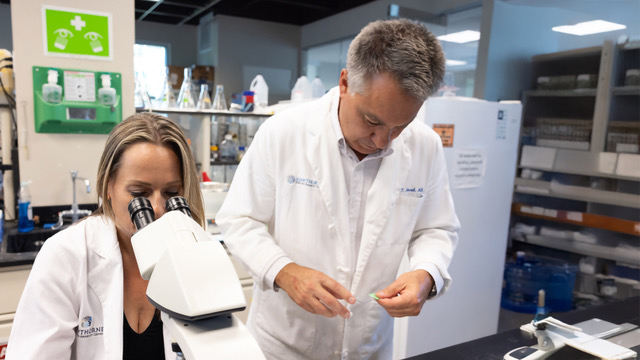
Dr. Nicholas Monsul and Dr. Eva Berkes in Quorum Innovations Lab
Peer-reviewed research reports the first human proof-of-concept evidence of a technology intentionally designed to capture microplastics
This is an important because it moves the science beyond simply identifying plastics in the environment and the human body”
SARASOTA, FL, UNITED STATES, September 23, 2026 /EINPresswire.com/ -- Micro- and nanoplastics have become a growing worldwide concern. These particles are now found throughout the environment - in the air we breathe, the water we drink and the food we eat - and have been detected in multiple tissues within the human body.— Dr Eva Berkes
Avoiding plastic water bottles, replacing plastic cutting boards and not microwaving food in plastic may help reduce exposure, but these steps alone are not enough. Plastics are now so widespread in modern life that exposure is increasingly difficult to avoid.
New peer-reviewed research by scientist worldwide was published in Frontiers in Microbiology reports the first human in-vivo proof-of-concept evidence of an administered technology, Qi601 intentionally designed to find and physically capture microplastics in a human setting.
The study evaluated Qi601, a proprietary, heat-inactivated postbiotic, intentionally designed and developed by Quorum Innovations, Inc., to bind microplastics in the gut and prevent absorption before it get absorbed into the body. The research demonstrates a fundamentally different approach to addressing plastic exposure: physically capturing micro- and nanoplastics before they have an opportunity to interact with intestinal cells, by creating large aggregates that are too big to be absorbed across the GI tract.
A First-of-Its-Kind Human Study
In the human proof-of-concept portion of the study, researchers directly observed microplastic particles physically associated with Qi601 agglomerates in saliva after exposure to microplastics released from chewing gum.
The study reports the plastics particles found in normal chewing gum was sequestered by Qi601 in the gum-plus-Qi601 in salvia samples collected. Approximately 91% of the plastics in the mouth was bound by Qi601 in the saliva and was lower than in the gum-only saliva when compared with the gum only sample.
According to the authors, this is the first published human in-vivo proof-of-concept study directly demonstrating physical association between microplastic particles and an administered intervention intentionally designed to capture plastics.
“This is an important milestone because it moves the science beyond simply identifying plastics in the environment and the human body,” said Eva A. Berkes, MD, co-founder and Chief Science Officer of Quorum Innovations and lead author of the study. “For the first time, a published human proof-of-concept study shows a technology intentionally designed to capture microplastics physically associating with those particles in a human setting. It opens the door to an entirely new way of thinking about unavoidable plastic exposure.”
Approximately 92 Percent Depletion During Simulated Digestion
The human findings were supported by multiple, orthogonal laboratory studies designed to examine how Qi601 interacts with micro- and nanoplastics under conditions relevant to human digestion.
During simulated oral, stomach and intestinal digestion, Qi601 produced approximately 92% depletion of free nanoplastic-associated fluorescence from the surrounding liquid. Qi601 retained the plastic particles by up to 92% and the aggregates were too larger to be absorbed across the GI tract. This technology facilities excretion of retained plastics particles in Qi601 the “natural way”.
The study also examined whether captured nanoplastics could transfer from Qi601 to human intestinal cells. When nanoplastics were first captured within Qi601 agglomerates, subsequent transfer of nanoplastic-associated fluorescence to intestinal cells was remained at 0.057% or less. Thus, the Qi601 and plastics particles were not transferred to human cells.
“This represents a fundamentally different approach to the plastics problem,” said Nicholas T. Monsul, MD, co-founder scientist and Officer of Quorum Innovations and a co-author of the study. “We cannot simply eliminate plastic from our lives. The goal of Qi601 is barrier protection - physically sequestering these particles within the gastrointestinal environment and reducing the amount available to interact with or enter intestinal cells and facilitate excretion. Instead of asking people to avoid every possible source of plastic in the food we eat to air we breath, we are developing technology intended to help protect the body from the exposure that cannot realistically be avoided.”
A Non-Living Postbiotic Barrier
Qi601 is a non-viable, heat-inactivated postbiotic derived from Limosilactobacillus fermentum LfQi6. It does not need to remain alive, reproduce or colonize the intestinal tract. It forms large biofilm-derived agglomerates capable of physically associating with micro- and nanoplastic particles, forming an adhe3sive barrier capturing plastic particles that are too big to be absorbed across the GI tract.
The LfQi6 source of Qi601, has been determined to be Generally Recognized as Safe for its intended use. The U.S. Food and Drug Administration issued Quorum a GRAS Notice GRN 000988.
This published findings support a new strategy described by the researchers as postbiotic sequestration: intercepting micro- and nanoplastics within the gastrointestinal environment and reducing the amount available to interact with the intestinal barrier. This also circumvents the possibility that a live biofilm probiotic with plastics stuck to it may be absorbed across the GI tract.
The current research establishes proof of concept. Larger controlled human studies are underway to demonstrate clinical efficacy and determine the gastrointestinal fate and elimination of particles captured by Qi601.
The study, “Postbiotic sequestration of micro- and nanoplastics: in vitro intestinal epithelial protection and proof of concept in the human mouth,” was published in Frontiers in Microbiology on September 21, 2026.
About Quorum Innovations
Quorum Innovations, Inc., based in Sarasota, Florida, is a biotechnology company founded by two physician scientists, Eva Berkes, M.D. and Nicholas Monsul M.D., trained at Yale University School Medicine, The Johns Hopkins Hospital and The Scripts Institute and Research Center. They have focused their research on the beneficial properties of the human microbiome centered on barrier protection.
Quorum Innovations is the recipient of two Defense Advanced Research Projects Agency Direct-to-Phase II awards for the development of barrier-defense technology for warfighters against chemical biological threats. The same core principles developed for the Department of Defense - strengthening barriers against environmental threats - is now being applied to protecting people from unavoidable micro- and nanoplastic exposure. Qi601® was specifically developed for the purposes of providing barrier protection against plastics absorption for humans. They have been awarded over 55+ patents in the US and internationally for the ground breaking inventions.
Qi601® is Quorum Innovations’ proprietary discovery. Its ability to physically capture micro- and nanoplastics in a first in human study designed to support the availability of these particles for absorption into the body.
Study and Media Information
Study https://doi.org/10.3389/fmicb.2026.1881786
Web sources Qi601.com, MyGutGuardian.com, Quoruminnovation.com
Media Contact Quorum Innovations, Inc., pam.media@QuorumInnovations.com
Pamela McCoy
Quorum Innovations
+1 727-314-2071
email us here
Legal Disclaimer:
EIN Presswire provides this news content "as is" without warranty of any kind. We do not accept any responsibility or liability for the accuracy, content, images, videos, licenses, completeness, legality, or reliability of the information contained in this article. If you have any complaints or copyright issues related to this article, kindly contact the author above.
